Workouts
Resistance Bands for Pull Ups (2026): Pick, Set Up, Progress
An assistance calculator shows why band help fades near the bar, plus a progression plan.
- 6 min read
- 5 sources
- Calculator
Set-ups from loop to barbell, with load math for the bottom and top of the rep.
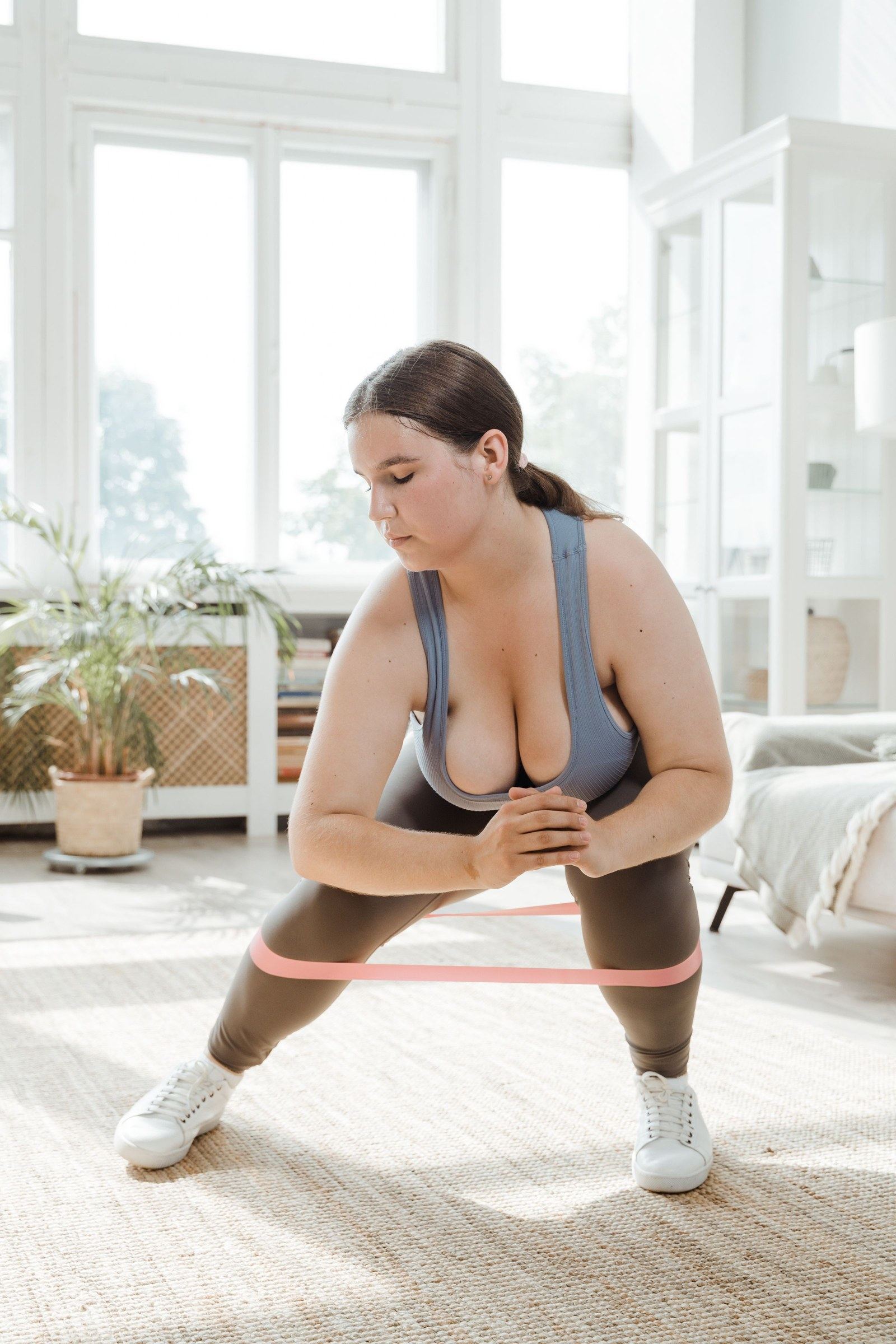
A resistance band squat is a squat where an elastic band adds load as you stand up. You can stand on a loop band and hold it at your shoulders, wear a short band above your knees or hang bands from a barbell. Each version changes where the squat feels hardest.
This guide covers clean resistance band squat form for each set-up. It also shows, with numbers, how much load a band really adds at the bottom and the top, and what the research says about bands on a bar.
To do a resistance band squat, stand on a loop band with both feet shoulder-width apart and hold the top at your shoulders. Sit your hips back, keep your chest up and stand tall. The band adds little at the bottom and the most at the top, so it loads the strongest part of the squat.
The biggest change is in the research. A 2025 meta-analysis looked only at the squat and pooled 20 studies of “variable resistance,” which means bands or chains added to the bar. It found elastic bands worked well for building maximal strength, with the clearest gains in trained lifters and in short training blocks.
Home band sets have also grown heavier. Rogue Fitness now lists long bands up to 225 lb at a full stretch. That makes band-only squats a real option for strong lifters, not just beginners.
This is the standard version with a long loop band.
Go as deep as you can with good form. A full range of motion matters here, because the band gives you very little help or load at the bottom.
The band’s position changes what a resistance band squat trains.
A long loop band under the feet suits home training. A short band above the knees is a good warm-up. Bands on a bar are for lifters who already squat with weights.
A band pulls harder the more it stretches. In a resistance band squat, it is shortest at the bottom and longest at the top. So the load climbs as you stand.
We modeled a Rogue #3 green Monster Band, rated at 40 lb at a 100% stretch. The 41-inch loop lies flat at 20.5 inches. Say it stretches to 30 inches at the bottom of your squat and 48 inches at the top.
| Point in the squat | Band length | Stretch | Band load |
|---|---|---|---|
| Bottom | 30 in | 46% | 18.5 lb |
| Top | 48 in | 134% | 46.3 lb |
The band pulls about 2.5 times harder at the top than at the bottom. Your lengths will differ with your height and where you hold the band. These are estimates from the maker’s rating, not lab measurements.
Enter your band’s rating, its resting length and how long it is at the bottom and top of your squat. Add any bar weight to see the total.
TheraBand advises against stretching its bands past three times their resting length. If your top length goes beyond that, use a heavier band rather than more stretch.
Strength coaches hang bands from the bar to make the top of the squat harder. Here is what that looks like with numbers.
Take a 185 lb bar and two Rogue #4 black bands, each rated at 65 lb, anchored near the floor. Say each band stretches to 22 inches in the hole and 40 inches at lockout.
At lockout, the bands make up about 40% of the load. That is the point. You get a heavy top half without a crushing load at the bottom.
Two reviews support adding bands to the bar, mainly for trained lifters.
A 2015 meta-analysis by Soria-Gila and colleagues in the Journal of Strength and Conditioning Research pooled 7 studies with 235 people. Training with bands or chains for 7 to 24 weeks added about 5.03 kg more to one-rep max than regular lifting. In trained lifters the gap was 6.12 kg. In untrained people it was 2.56 kg and not significant.
The 2025 squat-only review found bands had a moderate effect on maximal strength. The effect was clearest in trained lifters, in blocks under 8 weeks and at 2 sessions a week or fewer.
Not every trial agrees. In a 10-week study of 32 women, squat strength rose 25% with bands added to free weights and 23% with free weights alone. Both groups improved by about the same.
Bands load the top of the squat. That helps if the top is where you fail. An answer on Physical Fitness Stack Exchange put it plainly: bands and chains make a lift harder at lockout, which is useful “if lockout is actually your sticking point.”
If you fail at the bottom, bands do little for that weak spot. For a beginner, a resistance band squat is a good way to learn the movement with light load. For a strong lifter, a band-only squat may not load the bottom enough. Our resistance bands vs weights guide covers that trade-off.
A resistance band squat is easy at the bottom and hard at the top. That makes it a great home exercise and a useful add-on for strong lifters whose weak point is lockout. Learn the form with a light band, measure your stretch and add bands to a bar only once you squat with weights.
Written by the Workout Resistance Bands research desk
We pull numbers from primary sources, show our working and fix mistakes in public. First published . Spot an error? Tell us and we will correct it and change the date above.
Workouts
An assistance calculator shows why band help fades near the bar, plus a progression plan.